

BioCircuit Serums Market is Set to Surge at 13.2% CAGR From 2026 to 2036, Driven by Science-Backed Skincare Innovation
BioCircuit Serums Market
Germany’s skincare market grows at a 15.2% CAGR, driven by strict EU cosmetic regulations that favor pharmacy-grade efficacy and verified safety claims.
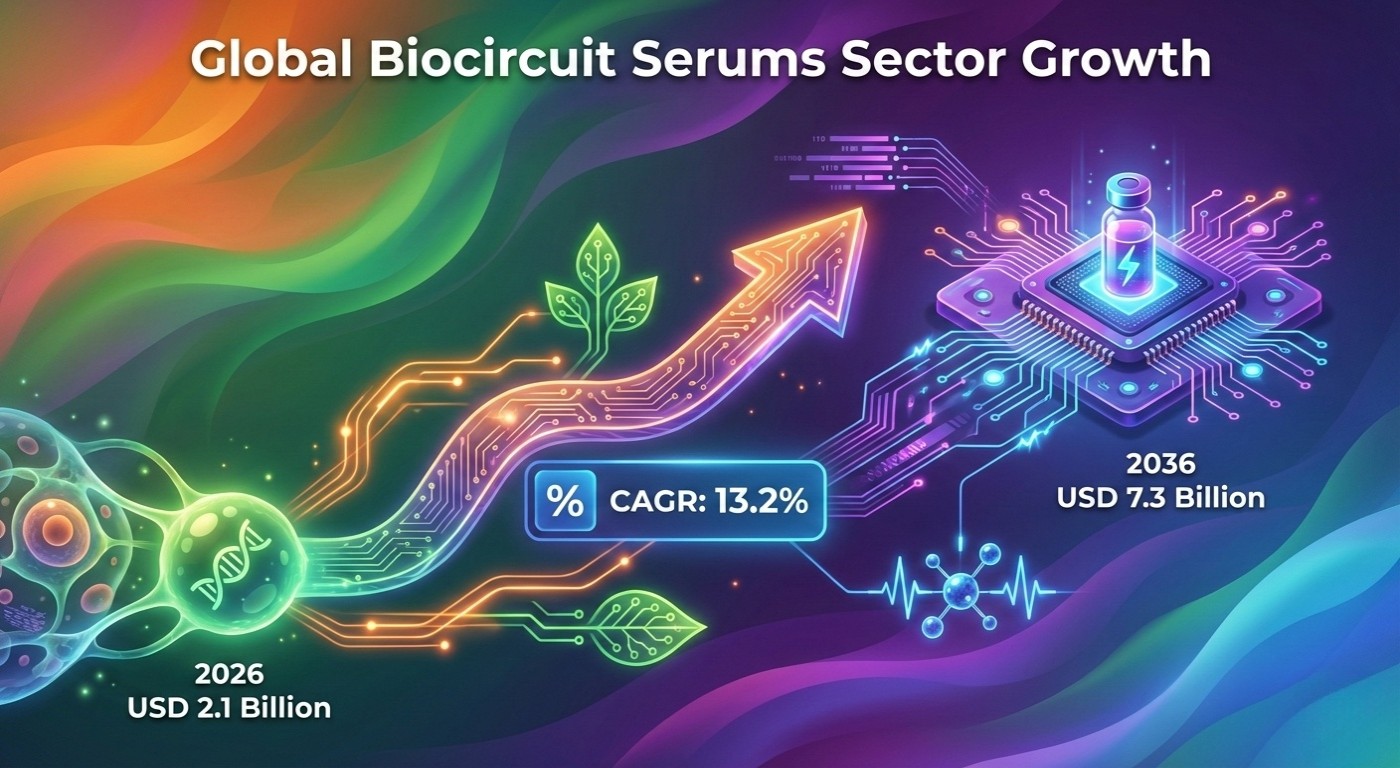
NEWARK, DE, UNITED STATES, February 6, 2026 /EINPresswire.com/ -- The global BioCircuit Serums Market is entering a decade of accelerated, science-driven growth, expanding from USD 2.1 billion in 2026 to USD 7.3 billion by 2036, at a projected compound annual growth rate (CAGR) of 13.2%, according to analysis by Future Market Insights (FMI). The expansion reflects a structural shift in premium skincare toward biologically grounded formulations that address age-related declines in skin bioelectric activity and cellular communication.
BioCircuit serums represent an emerging category of advanced topical skincare formulated with bioelectric signal–modulating peptides, ion channel–targeting compounds, and cellular communication enhancers. These formulations are designed to influence membrane potential, gap junction activity, and voltage-gated channel function mechanisms increasingly validated by dermatological research as critical to skin repair, barrier restoration, and aging mitigation.
Explore Opportunities – Get Your Sample of Our Industry Overview Now!
https://www.futuremarketinsights.com/reports/sample/rep-gb-31844
Market Context: Why Bioelectric Skincare Is Gaining Clinical and Commercial Traction
Dermatological research demonstrates that chronological and photoaged skin exhibits reduced transmembrane voltage potentials and impaired cellular signaling, correlating with slower repair, inflammation, and loss of firmness. This scientific foundation is compelling formulators to design peptide circuits and bioactive compounds that support natural electrical signaling without applying external current—an approach that allows products to remain within cosmetic regulatory frameworks.
Major industry players are investing in cellular biology research. In its 2023 Annual Report, L’Oréal Group, parent company of SkinCeuticals, highlighted continued investment in understanding cellular communication and environmental stress response, underscoring how bioelectric concepts are advancing within professional skincare portfolios, even as the segment remains emerging.
At the same time, regulatory boundaries are shaping product positioning. Cosmetic brands must carefully avoid claims that would classify formulations as medical devices under U.S. FDA or EU frameworks, reinforcing a focus on supporting natural cellular function rather than delivering electrical current.
BioCircuit Serums Market: Key Takeaways
• Market Size (2026): USD 2.1 Billion
• Market Value (2036): USD 7.3 Billion
• CAGR (2026–2036): 13.2%
FMI’s projections are based on proprietary forecasting models integrating advanced peptide technology adoption curves, dermatologist-recommended product penetration, and consumer awareness trajectories shaped by familiarity with microcurrent facial devices.
What Is Driving Adoption of BioCircuit Serums?
Several converging factors are accelerating adoption across professional and consumer channels:
• Microcurrent device proliferation has established consumer awareness that electrical signaling influences skin behavior, lowering education barriers for topical bioelectric serums.
• Dermatologist endorsement is increasing as bioelectric serums are incorporated into post-procedure protocols following laser resurfacing, chemical peels, and microneedling.
• Clinical evidence, including published research in the Journal of Cosmetic Dermatology, supports the role of peptide-based bioelectric modulators in wound healing and inflammation reduction.
These dynamics are transforming bioelectric serums from cosmetic novelties into evidence-supported adjuncts within dermatology treatment algorithms.
Market Segmentation Reflects Clinically Interpretable Use Cases
The BioCircuit Serums Market is segmented by product type, technology, skin concern, distribution channel, end user, and region:
• By Product Type: Skin repair serums dominate, followed by anti-aging, hydration-boosting, and brightening formulations.
• By Technology: Bioelectric signal modulation leads adoption, ahead of peptide circuit systems, microcurrent-activated formulations, and cell signaling pathway formulas.
• By Distribution Channel: Online direct-to-consumer platforms account for the largest share, supported by dermatology clinics and medical spas.
FMI analysis indicates that repair-first positioning builds professional trust, enabling later expansion into broader aesthetic applications.
Why Skin Repair and Bioelectric Signal Modulation Lead
Skin repair BioCircuit serums hold 38.4% of product-type share, supported by robust evidence linking barrier disruption to altered bioelectric gradients. Research published in the International Journal of Molecular Sciences validates measurable improvements in transepidermal water loss, inflammation markers, and stratum corneum integrity following peptide-mediated electrical gradient restoration.
On the technology front, bioelectric signal modulation accounts for 44.7% of market share, reflecting its specificity and intellectual property defensibility. Targeted peptides interacting with voltage-gated calcium and potassium channels and connexin proteins provide competitive advantages through patent protection and clinical differentiation.
Regional Outlook: Growth Anchored in Professional Authority
FMI forecasts uneven but robust regional expansion:
• China: 17.8% CAGR, driven by biotech-enabled functional cosmetics and regulatory support for efficacy-driven skincare
• India: 16.5% CAGR, supported by rapid expansion of dermatology and aesthetics networks
• Germany: 15.2% CAGR, shaped by stringent EU cosmetic safety standards and pharmacy-led trust
• Brazil: 13.9% CAGR, reflecting integration of aesthetic medicine and prestige beauty
• United States: 12.5% CAGR, supported by dermatologist recommendations and regulatory clarity
• United Kingdom: 11.2% CAGR, driven by science-led “clean tech” beauty adoption
Competitive Landscape: IP, Clinical Validation, and Ecosystem Partnerships
Competition is defined less by marketing scale and more by intellectual property strategy, academic collaboration, and clinical substantiation. Leading companies are securing peptide sequence patents, partnering with universities, and investing in objective measurement methodologies such as bioimpedance spectroscopy and ion flux assays.
Recent developments include:
• February 2024: SkinCeuticals launched an advanced bioelectric peptide serum targeting gap junction communication.
• October 2025: Allergan Aesthetics refreshed SkinMedica® packaging, emphasizing sustainability and professional navigation.
Market Definition and Scope
The BioCircuit Serums Market encompasses premium topical facial serums formulated to influence skin bioelectric activity through advanced peptide technology. The market excludes conventional peptide serums without bioelectric substantiation, microcurrent devices, injectables, and mass-market formulations.
Why FMI: https://www.futuremarketinsights.com/why-fmi
Have a Look at Related Research Reports on the Consumer Product Domain:
Sexual Wellness Market https://www.futuremarketinsights.com/reports/sexual-wellness-market
Pet Toys Market https://www.futuremarketinsights.com/reports/pet-toys-market
Diamond Jewelry Market https://www.futuremarketinsights.com/reports/diamond-jewelry-market
Sun Care Products Market https://www.futuremarketinsights.com/reports/sun-care-products-market
About Future Market Insights (FMI)
Future Market Insights, Inc. (FMI) is an ESOMAR-certified, ISO 9001:2015 market research and consulting organization, trusted by Fortune 500 clients and global enterprises. With operations in the U.S., UK, India, and Dubai, FMI provides data-backed insights and strategic intelligence across 30+ industries and 1200 markets worldwide.
Sudip Saha
Future Market Insights Inc.
+1 347-918-3531
email us here
Legal Disclaimer:
EIN Presswire provides this news content "as is" without warranty of any kind. We do not accept any responsibility or liability for the accuracy, content, images, videos, licenses, completeness, legality, or reliability of the information contained in this article. If you have any complaints or copyright issues related to this article, kindly contact the author above.
