

IAM Journal: Santa Ana Inferno
This article was featured in the Summer 2026 IAM Journal and was written by IAM Communications Representative Bill Harkum
“People were literally just running for their lives,” said IAM California Fire Pilots Association member and Cal Fire pilot Keith Eyler. Around 10:30 a.m. on Jan. 7, 2025, Santa Ana winds reignited a brush fire near Temescal Canyon in the Pacific Palisades neighborhood northwest of downtown Los Angeles. By 2 p.m., steady winds around 60 mph had turned the hills behind that neighborhood into the nightmare inferno that movies are made of in nearby Hollywood. Fire was spreading so quickly that the only exit by road, Palisades Drive, was on fire on both sides of the street. People panicked.
Police officers started running through the stalled traffic, yelling at motorists to “run for their lives,” leaving their cars unlocked and keys in the ignition. Inside the inferno, people faced the option of running or staying in their cars, hoping someone would help.
Above them in the skies was a Cal Fire S-2 tanker plane, piloted by Eyler.
“My mission changed from firefighting to life saving,” said Eyler. “I literally had to put a load of time on the ground to save lives.”
Phos-check, the load of “time” Eyler puts on the ground from his S-2 tanker aircraft, is a water-and-fertilizer compound fire retardant that turns big flames into smaller ones, but it often does not douse them completely.
It only buys time. Time to run. Time to escape the fire, as an LA traffic jam trapped hundreds of neighbors in one of the worst wildfires in California’s history. On this day, it probably saved hundreds of lives.
Cal Fire uses multiple aircraft for aerial fighting. Many are former military equipment – from C-130 Hercules aircraft, UH-1 Huey Helicopters, S-70i Firehawk Helicopters, OV-10 spotter aircraft, to the venerable S-2 tanker aircraft that Keith Elder flew above the Palisades fire. Cal Fire operates 23 turbine powered S-2 planes over the past 20 years, each providing stable jobs to IAM members at Cal Fire Aviation located at McClellan Airpark in Sacramento. Cal Fire has operated S-2 type aircraft in the State of California since the early 70’s.
“We do a lot of flying that would get a regular pilot in trouble with the FAA,” said Eyler. “People really appreciate when we fly through their backyards at 150 feet to save their home, but that’s not normal.”
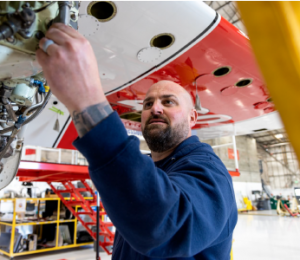
IAM Local 93 member Greg LaFrancis
inspects a component on an OV-10
spotter aircraft at McClellan Air Park in
Sacramento, California.
There are approximately 100 flight certificates for this kind of flying for aerial firefighting, and IAM members hold almost one-third of those special certificates. These pilots also rely on skilled union aircraft mechanics to ensure these aircraft will not fail while flying at 150 feet above the ground or while dropping below the rim of mountain canyons in 60 to 100 mph swirling winds.
“Many of us are prior military service members, so we are used to uniforms,” said Greg LaFrancis, a lead technician and Local 946 member. “Our union membership is like a cloak – an invisible cloak. The cloak is there when we need it, and we all know we wear it. It reminds us of the team we represent.”
“When this unit joined the IAM in 2001, it transformed this industry – full stop,”
said IAM California Fire Pilots Association’s Colin Rodgers. “Before the union, we had off seasons where some employees were effectively laid off. The Union changed that and it moved aerial firefighting operations to full-time skilled professional union work.”
Just like traditional firefighters, their profession has evolved to high standards and rigorous maintenance of their equipment, even when not actively fighting fires.
“These members are courageous and admirable people,” said IAM Western Territory General Vice President Robert “Bobby” Martinez. “Day in and day out, they are the line of defense against wildfires that threaten citizens and property across our great country.”
Wildfire also broke out in the San Gabriel Mountains above Pasadena that same evening of Jan. 7. Santa Ana winds drove that fire to triple in a matter of 12 hours.
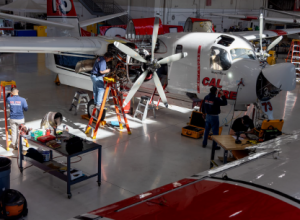
IAM Local 93 members working for Cal
Fire service an S-2 aerial tanker aircraft.
Many of these firefighting aircraft fly
below 1,000 feet above populated areas,
requiring zero defects in maintenance.
“If you can’t outrun the wind, you are not going to outrun the fire,” said NFFE-IAM Fire Captain Eduardo Cerna, one of the initial responders to the Eaton Fire. “It’s like standing in front of a freight train. You have a matter of minutes to get out of its way, that’s all you can do.”
The San Gabriel Mountains run east to west just outside Los Angeles, one of a handful of mountain ranges on the planet with that topography.
Because the LA side of the mountain range faces the sun most of the day, vegetation dries out quicker and becomes fire fuel, just waiting for a spark.
Weather in the deserts of Nevada and Utah impact these mountains with a wind funnel effect known as the Santa Ana winds. Legend has it that the Spanish settlers gave these winds that name intending to call it “the devil’s breath,” of hot, dry air with speed near hurricane force level. In January 2025, some Santa Ana wind gusts around LA reached 100 mph, lasting 20 to 30 minutes straight.
NFFE-IAM Battalion Chief Gregory Stenmo has been fighting wildland fires for more than twenty years across the United States. He has faced many fires in the Angeles National Forest.
“We were returning from another fire when the first call came out,” said Stenmo. “We were six minutes away. When we arrived, it was the first time in my career that I called for other responding units to stay away. It was moving too fast.”
Stenmo’s brother had a house in the area. Gregory sent his brother a text to move now because the fire was racing across the face of the mountains. “Ember wash” was already circulating in the community. It was too late. Gregory’s brother’s house was lost in the first 10 minutes of the fire. Stenmo had never seen fire behavior like this in his 20-plus-year career.
“Typically, we see structure fires in the first two to five blocks of a community with a wildland, urban interface,” said NFFE-IAM Fire Captain Robert Robledo, one of the initial attack crews. “With this fire, we were 25 to 30 blocks into the community with the ember cast, and the structure fires would just domino.”
Instead of running a hose, they were using large trash bins dipped in backyard pools to attack spot fires, and just being able to move when they had to quickly.
The dominoes were falling fast.
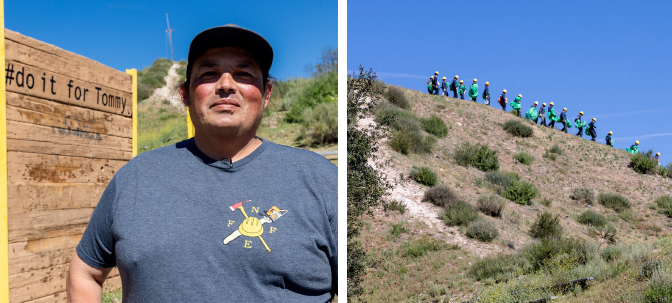
Left, NFFE-IAM member Greg Stenmo at San Gabriel Mountains National Monument. He stands next to a wall that trainees navigate during training. Right, NFFE-IAM trainees walk a ridgeline at the San Gabriel Mountains National Monument. They carry their New Generation Fire Shelters for this exercise to make sure they can protect themselves as a last resort.
“Once there were homes on one block fully involved, dozens more were in danger, so we started attacking the front edge of the fire to create the Venturi effect,” said Stenmo. “That [difference in] air pressure allows the Venturi effect to create [fire] tornadoes. It would pull back into itself and usually away from the uninvolved homes. We saved a lot of structures that way, and I credit these crews with improvising those tactics to save as much as we could.”
More than 9,000 homes and structures were lost in the Eaton fire, most in the Altadena Community. Nineteen people lost their lives. Twelve more were lost in the Palisades fire, and nearly 7,000 homes and structures were lost. None were reported lost in the traffic jam that IAM Pilot Keith Eyler targeted with his “load of time.” During the week of Jan. 7, almost 200,000 residents of Los Angeles County were under evacuation orders.
NFFE-IAM Business Representative Steve Gutierrez represents many of the wildland firefighters who work for the federal government.
“If we don’t continue to control the fuel loads and manage the land, it will lead to more high-intensity fires,” said Gutierrez. “Fires like the Altadena and Eaton fires are going to keep happening. We need more workers because fuel management is the key to fighting these types of fires before they start. Water can only do so much.”
“Our Forest Service members do the back-breaking, hard work to maintain these beautiful natural resources for everyone’s use, and keep all of us safe as possible by managing the fuel loads that can feed high-intensity wildfires,” said NFFE-IAM National President Randy Erwin. “We fought to get these members fair pay, and now we are honored to try to make these workers’ quality of life better with each year in our union.”
Greg Stenmo retired from a 20-year U.S. Forest Service career two days after his IAM Journal interview.
“If the kids that start here now get $50,000 more a year the day after I retire, good for them,” said Stenmo. “If things improve for them, I’d be happy for them. I wouldn’t care that I didn’t get it while I served. We need to get away from that old mentality of ‘you don’t get it, if I never got it,’ you know. And I see the union having the impact to change that for the good of everybody.”
Legal Disclaimer:
EIN Presswire provides this news content "as is" without warranty of any kind. We do not accept any responsibility or liability for the accuracy, content, images, videos, licenses, completeness, legality, or reliability of the information contained in this article. If you have any complaints or copyright issues related to this article, kindly contact the author above.
