
Ayurveda Market to reach USD 107.62 Billion by 2035 at 17.82% CAGR
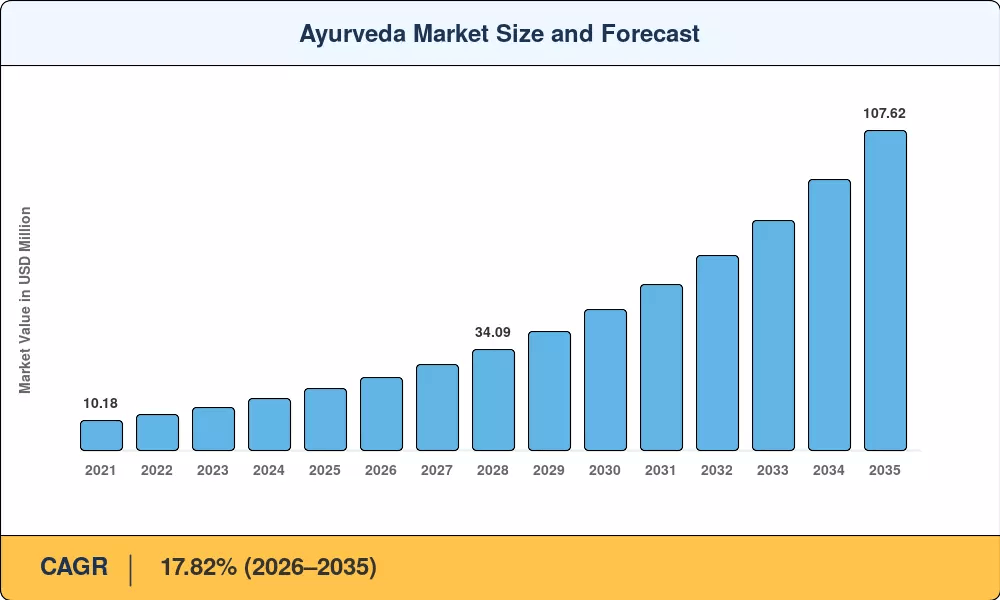
Ayurveda Market Size
Ayurveda Market to Surge from USD 24.55 Billion in 2026 to USD 107.62 Billion by 2035- Powered by Plant-Based Wellness, AYUSH Infrastructure
NY, CA, UNITED STATES, June 10, 2026 /EINPresswire.com/ -- As per Market Research Future, the global Ayurveda Market size to reach USD 107.62 Billion by 2035 from USD 24.55 Billion in 2026, at a CAGR of 17.82% during the forecast period 2026--2035. The market base was estimated at USD 20.84 Billion in 2025.The 17.82% CAGR---nearly double the growth rate of the broader pharmaceutical sector---is driven by three converging structural forces: the global consumer pivot toward plant-based wellness that has made herbal medicine formulations a mainstream pharmacy category across Western Europe and North America, the regulatory acceleration of traditional herbal registrations and GMP-certified manufacturing standards, and the emergence of e-commerce and digital distribution platforms capable of delivering verified Ayurvedic products to consumers worldwide within 48 hours.
National governments are amplifying this momentum. India's National AYUSH Mission has channeled over USD 580 million into traditional Indian healing infrastructure since 2020, with the Union Budget allocation expanding to INR 4,408.93 crore for the 2025--26 fiscal cycle. The EU's Traditional Herbal Medicinal Products Directive enables standardized registrations across member states, while the U.S. herbal supplement market reached a record USD 13.23 billion in 2024 according to SPINS and Nutrition Business Journal tracking data. Together, these initiatives are creating the institutional frameworks on which standardized dosha-based therapy regimens and clinically verified product lines depend.
Request A Free Sample: https://www.marketresearchfuture.com/sample_request/6166
Key Market Trends & Growth Drivers
National AYUSH and Government Policy Support
Government-funded AYUSH infrastructure programs are the single largest structural driver of the Ayurveda Market through 2035. National initiatives---including India's Ministry of AYUSH modernization of state-of-the-art AYUSH hospitals, the Pharmacopeia Commission for Indian Medicine and Homeopathy (PCIM&H) standardization metrics, and the All India Institute of Ayurveda (AIIA) international research collaborations---are collectively creating competitive herbal medicine formulation environments across all major geographies.
Early-adopter health systems report that integrative medicine departments at leading academic medical centers including the Cleveland Clinic and Johns Hopkins now offer holistic health options to patients, incorporating traditional mind-body modalities as non-pharmacological therapies for chronic pain, stress management, and functional digestive disorders.
E-Commerce and Digital Distribution Platforms
E-commerce infrastructure has become a primary catalyst for the Ayurveda market's mainstream expansion. In February 2022, Amazon India officially launched its dedicated Ayurveda Storefront, curated directly alongside support from the Ministry of AYUSH to dramatically increase the digital visibility of verified small businesses and direct-to-consumer (D2C) wellness brands. Major digital health platforms---including Tata 1mg and PharmEasy---have similarly integrated dedicated herbal and Ayurvedic segments.
Digital wellness applications are increasingly deploying user-inputted biometric data and comprehensive lifestyle questionnaires to generate personalized wellness recommendations. By evaluating dynamic lifestyle habits alongside metabolic profiles, these mobile systems align traditional holistic paradigms with modern consumer habits, creating an interactive digital software layer atop the traditional product market.
Clinical Validation and Institutional Research
The National Institutes of Health (NIH) allocated USD 47 million in 2024 toward integrative medicine grants that include Ayurvedic protocols for metabolic syndrome and inflammatory conditions. Academic publications on panchakarma detox therapy outcomes have tripled since 2018, strengthening the evidence base that payers and regulators require before expanding coverage. The Central Council for Research in Ayurvedic Sciences (CCRAS) has finalized scores of international and domestic research collaborations to accelerate global evidence-generation and establish strict clinical baselines.
In November 2022, Mankind Pharma's acquisition of Upakarma Ayurveda signaled that multinational pharma corporations now saw Ayurvedic dietary practices as a legitimate growth vertical worth deploying significant capital on. This milestone illustrates how clinical validation is directly accelerating standardized dosha-based therapy commercialization.
Ask for Customization: https://www.marketresearchfuture.com/ask_for_customize/6166
Market Segment Insights
BY FORM
Herbal: Dominant segment with ~52% share in 2025. Consumer preference for plant-derived herbal medicine formulations with transparent ingredient lists; Ashwagandha, turmeric, and triphala formulations drive over 60% of the herbal segment revenue.
Herbomineral: Fastest-growing form at 19.4% CAGR (2026--2035). Clinician interest in synergistic mineral-herb compounds for chronic disease management; combining metallic or mineral compounds with botanical extracts for metabolic and musculoskeletal conditions.
Mineral: USD 2.71 Billion revenue in 2025. Demand for Bhasma-based traditional Indian healing products in South Asian markets; traditional mineral-based formulations anchored by regional practitioner loyalty.
Other Forms (Tablets, Capsules, Liquid, Powder): 13.1% CAGR (2026--2035), representing next-generation delivery system frontiers for dosha-based treatment protocols.
BY APPLICATION
Medicinal: Dominant application with ~61% share in 2025. Dosha-based treatment protocols gain traction in integrative medicine clinics; spans prescription Ayurvedic formulations, OTC herbal supplements, and clinical panchakarma detox therapy services.
Personal Care: Fastest-growing application at 18.9% CAGR. Clean-beauty trends and rising consumer adoption of Ayurvedic dietary practices in skincare; multinational beauty conglomerates including L'Oréal and Unilever source traditional Indian healing ingredients for premium product lines.
Skin and Hair Care: 38% share of indication segment in 2025, propelled by convergence of clean-beauty consumer demand and traditional Indian healing formulations rich in neem, amla, and bhringraj.
Gastrointestinal: 18.6% CAGR (2026--2035), fueled by triphala-based herbal medicine formulations and panchakarma detox therapy protocols gaining recognition in integrative gastroenterology.
BY DISTRIBUTION CHANNEL
Business to Consumer (B2C): Largest segment at ~58% share in 2025, with direct-to-consumer genomic testing gaining traction through digital platforms and wellness tourism. Business to Business (B2B): USD 8.7 Billion in 2025, with third-party WHO-GMP-certified facilities in India allowing foreign wellness companies to outsource large-scale extraction, encapsulation, and packaging.
E-Commerce: Fastest-growing distribution channel at 22.1% CAGR, reflecting decentralized healthcare delivery and digital-first traditional Indian healing brands. Pharmacies and Supermarkets: ~15% share; mainstream retail channel expansion for standardized herbal medicine formulations.
Regional Outlook
Asia-Pacific --- Dominant Market (~44% Share, 2025)
India generates approximately 62% of Asia-Pacific Ayurveda Market revenue, driven by the AYUSH Mission's INR 4,408.93 crore budget allocation, a network of over 4,000 licensed manufacturers and 780,000 registered practitioners, and broad domestic adoption of pharmacogenomics panels. India's Traditional Knowledge Digital Library has documented over 300,000 formulations to prevent bio-piracy patents abroad.
China is growing at 17.4% CAGR on TCM--Ayurveda cross-pollination research funded by the State Administration of Traditional Chinese Medicine. Japan contributes USD 0.83 Billion (2025) through Kampo-adjacent consumer interest in dosha-based treatment. South Korea's K-beauty Ayurvedic ingredient sourcing is growing at 18.9% CAGR. The region accounted for USD 9.17 Billion in 2025.
North America --- Fastest-Growing Region (20.3% CAGR, 2026--2035)
The United States generates approximately 78% of North American Ayurveda Market revenue, driven by integrative medicine clinics in California, New York, and Texas serving as primary demand hubs, growing interest in panchakarma detox therapy among wellness-conscious customers, and the record USD 13.23 billion U.S. herbal supplement market in 2024.
Aetna's 2024 feasibility study on Ayurvedic chronic-pain protocols reported a 14% reduction in downstream specialist referrals. Canada is growing at 16.5% CAGR on Health Canada natural product licensing streamlining approval pathways for traditional Indian healing imports. Mexico's expanding middle class is discovering Ayurvedic dietary practices through cross-border e-commerce.
Europe --- Second Largest (USD 4.58 Billion, 2025)
Europe's Ayurveda Market benefits from the EU's Traditional Herbal Medicinal Products Directive enabling standardized registrations across member states. Germany leads regionally with 26% of regional share, leveraging its established Heilpraktiker (naturopathic practitioner) system to integrate Ayurvedic protocols into primary care.
The UK is growing at 19.1% CAGR anchored by post-Brexit independent herbal regulation attracting investment from Indian exporters. France contributes USD 0.57 Billion (2025) through pharmacy-channel herbal medicine formulations. Italy holds 11% of regional share with wellness tourism incorporating panchakarma detox therapy. Spain is growing at 16.2% CAGR on growing demand for natural cosmetics.
Middle East & Africa --- Emerging Opportunity (15.8% CAGR, 2026--2035)
Saudi Arabia's Vision 2030 wellness tourism investment accounts for 29% of regional share. The UAE's Dubai Healthcare City licensed its first standalone panchakarma detox therapy clinic in 2024, growing at 18.7% CAGR and supported by medical tourism. South Africa contributes USD 0.14 Billion (2025) through traditional healer--Ayurveda knowledge exchange.
India's Ministry of External Affairs has established AYUSH Information Cells in 35 countries across MEA, directly supporting the Ayurveda Market's expansion. Egypt is growing at 16.3% CAGR on herbal supplement import liberalization.
South America --- Growing Presence (USD 1.04 Billion, 2025)
Brazil anchors South America's Ayurveda Market at ~58% of regional revenue, with the Unified Health System (SUS) including Ayurvedic protocols in its Integrative and Complementary Practices policy in 2023, opening institutional procurement channels for herbal medicine formulations. Argentina's academic medical centers are emerging as regional hubs for natural product retail expansion, growing at 17.1% CAGR.
Read Detailed Insights: https://www.marketresearchfuture.com/reports/ayurveda-market-6166
Competitive Landscape and Recent Developments
The Ayurveda Market exhibits low concentration, with an estimated Herfindahl-Hirschman Index below 500 and the top five players collectively holding roughly 22--28% of global revenue. The landscape is highly fragmented, featuring thousands of regional manufacturers alongside a handful of pan-Indian and multinational brands scaling through M&A and digital distribution.
The competitive landscape is stratified between heritage brands controlling end-to-end traditional formulation and mass distribution workflows, mid-sized specialty firms focused on specific therapeutic areas, and digital-native disruptors reshaping discovery economics through e-commerce scale.
KEY COMPANIES AND RECENT MILESTONES
Dabur India Ltd. (September 2024): Expanded Chyawanprash and herbal medicine formulations portfolio with enhanced digital distribution reach. Estimated revenue share: ~5--8% of global Ayurveda Market.
Patanjali Ayurved Ltd. (November 2024): Strengthened OTC Ayurvedic products and Ayurvedic dietary practices and foods through value pricing and rural penetration. Estimated revenue share: ~4--7%.
Himalaya Wellness Company (March 2025): Launched new standardized herbal extracts and skincare lines backed by clinical research-driven positioning. Estimated revenue share: ~3--6%.
Mankind Pharma / Upakarma Ayurveda (November 2022): Acquired majority stake in Upakarma Ayurveda Private Limited, signaling big pharma's entry into the Ayurveda Market through digital-native herbal medicine formulations brands.
Estimated revenue share: ~1--2%.
Organic India (Tata Consumer) (April 2025): Expanded Tulsi teas and herbal supplements portfolio with organic certification and export focus. Estimated revenue share: ~1--2%.
Future Outlook: 2026--2035
By 2030, AI-driven personalized wellness platforms are expected to influence over 60% of Ayurvedic product selections in market leader countries, integrating user-inputted biometric data, lifestyle questionnaires, and dosha profiling algorithms into unified clinical dashboards. Decentralized clinical trials incorporating wearables, remote monitoring, and at-home sample collection are projected to represent 40% of Phase II/III precision Ayurveda trials by 2028, improving patient diversity and reducing trial dropout rates by 25%.
The next decade will see market consolidation around data-platform companies that aggregate botanical, clinical, and payer datasets at scale---creating recurring-revenue streams that mirror SaaS economics. WHO's Traditional Medicine Strategy 2025--2034 calls for internationally recognized safety and efficacy benchmarks for herbal medicine formulations, underscoring that health equity and commercial expansion are now aligned forces driving the Ayurveda Market to its USD 107.62 Billion 2035 destination.
As clinical evidence for panchakarma detox therapy outcomes strengthens, US and European insurers are expected to introduce coverage pilots by 2029. Broad insurance adoption could unlock an additional USD 8--12 billion in addressable Ayurveda Market revenue by 2035. Western clinics increasingly offer modular 3--5 day programs instead of traditional 21-day protocols, reducing cost barriers and integrating with employer wellness reimbursement programs. This adaptation has doubled clinic throughput in US metropolitan areas.
More Related Research Insights:
https://www.marketresearchfuture.com/reports/herbal-medicine-market-3250
https://www.marketresearchfuture.com/reports/nutraceuticals-market-2181
https://www.marketresearchfuture.com/reports/dietary-supplements-market-1134
https://www.marketresearchfuture.com/reports/botanical-extracts-market-4824
https://www.marketresearchfuture.com/reports/organic-personal-care-products-market-1957
https://www.marketresearchfuture.com/reports/alternative-medicines-therapies-market-26919
Larry Wilson
WantStats Research And Media Pvt. Ltd.
+1 855-661-4441
email us here
Visit us on social media:
LinkedIn
Facebook
YouTube
X
Legal Disclaimer:
EIN Presswire provides this news content "as is" without warranty of any kind. We do not accept any responsibility or liability for the accuracy, content, images, videos, licenses, completeness, legality, or reliability of the information contained in this article. If you have any complaints or copyright issues related to this article, kindly contact the author above.
