

AI and the US labour market: effects on employment growth
Prepared by Isabella Moder and Til Pommer
As firms around the world adopt AI tools, the impact of AI on labour markets is being widely discussed.[1] While AI’s potential to disrupt job markets could be significant, its effects on aggregate employment appear to be muted so far. Still, there is growing evidence that AI is negatively affecting employment for specific occupational sub-groups, particularly junior workers in highly exposed occupations.[2] This box analyses the effects of AI on employment growth in recent years, focusing on the United States, where such effects are likely to have become visible earlier than in other major economies, given that it is home to some of the most advanced early-adopting firms and has a relatively flexible labour market.
The impact of AI on job growth can be both positive and negative, as highlighted in recent literature on the subject. A well-known framework developed by Acemoglu and Restrepo (2018) distinguishes between the positive effect new technologies have on employment growth by enabling higher productivity, and the negative effect they create owing to job displacement, with the net impact on a country’s employment depending on the relative importance of those effects. Empirically assessing the impact of AI on employment at this early stage is difficult (Lane, 2026). Hampole et al. (2025) show that while in the United States firm-wide adoption of AI generates positive employment effects, these effects mask substantial heterogeneity across occupational groups. Initial evidence for the European Union suggests that firms that adopt AI technologies experience higher productivity gains, without the technology replacing labour in the short term (Aldasoro et al., 2026). This aligns with recent ECB survey findings that firms with high levels of AI adoption or AI-related investment are more likely to employ additional staff (Lebastard and Sondermann, 2026).
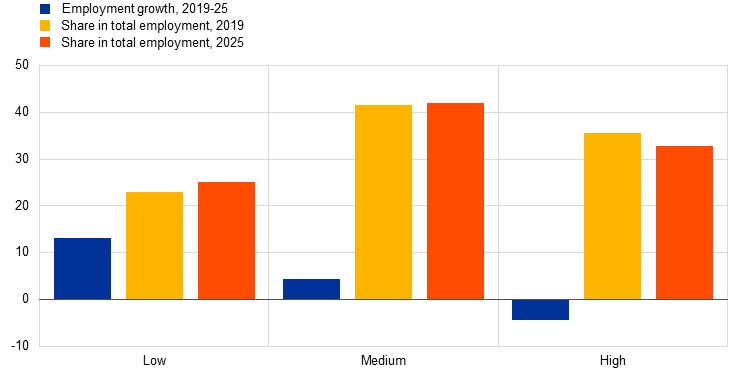
In the United States, the number of jobs in occupations with a high AI substitution risk has fallen in recent years. Applying an index developed by Pizzinelli et al. (2023) to measure AI substitution risk, each occupation is categorised into one of three categories, corresponding to a low, medium and high risk of AI substitution.[3] A calculation of average employment growth for each of those categories in the United States suggests that employment in jobs with a high risk of AI substitution (e.g. economists, graphic designers) declined on average by more than 4% between 2019 and 2025 (Chart A).[4] By contrast, employment in jobs with a low risk of AI substitution (e.g. electricians, high school teachers) increased by 13% over the same period. As a consequence, the composition of US employment has changed. The share of low-risk jobs in total US employment has increased from 23% to 25%, while the share of high-risk jobs has dropped from 35% to 33%.
Chart A
Employment growth and share in total employment of occupations grouped by AI substitution risk – United States
(percentages)
Sources: Bureau of Labor Statistics, Pizzinelli et al. (2023) and ECB staff calculations.
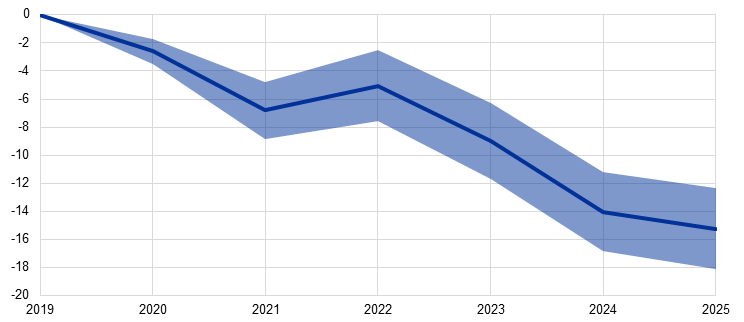
An empirical analysis confirms that AI has already led to a reallocation of jobs within the US labour market. The impact of AI substitution risk on employment growth is estimated using the same classification of occupations by level of AI substitution risk as before. The analysis uses a difference-in-difference approach and separately estimates the impact of an occupation’s risk of AI substitution on its employment growth for each year (2020-2025) compared with the base year (2019). It also includes a constant and sector-specific fixed effects corresponding to three-digit North American Industry Classification System (NAICS) subsectors, controlling for shocks (e.g. COVID-19), sector-specific developments and unobserved heterogeneities.[5] The results indicate a growing wedge between job growth in occupations with a high AI substitution risk compared with occupations with a low AI substitution risk (Chart B).[6] All else being equal, between 2019 and 2025 jobs with a high substitution risk grew by around 15 percentage points less than jobs with a low substitution risk. This is in line with studies showing that AI is affecting job growth for specific occupational sub-groups. Overall, while the consequences of AI for aggregate employment to date remain inconclusive, the analysis finds that it has had a relative impact on US employment growth since 2019.[7] This impact has accelerated since the launch of ChatGPT in late 2022.
Chart B
Impact of AI on US employment growth – difference between high and low risk of substitution
(percentage points)
Sources: Bureau of Labor Statistics, Pizzinelli et al. (2023) and ECB staff calculations.
Notes: The line shows the estimated relative impact of AI exposure on employment growth for each year compared with 2019. The model uses a difference-in-difference approach and separately estimates the impact of an occupation’s risk of AI substitution on its employment growth for each year (2020-2025) compared with the base year (2019). The top and bottom 1% of employment growth have been winsorised to control for outliers. The model also includes a constant and sector-specific fixed effects corresponding to three-digit NAICS subsectors. Results have been rescaled to indicate the difference between high and low AI substitution risk. The shaded area corresponds to the 95% confidence interval.
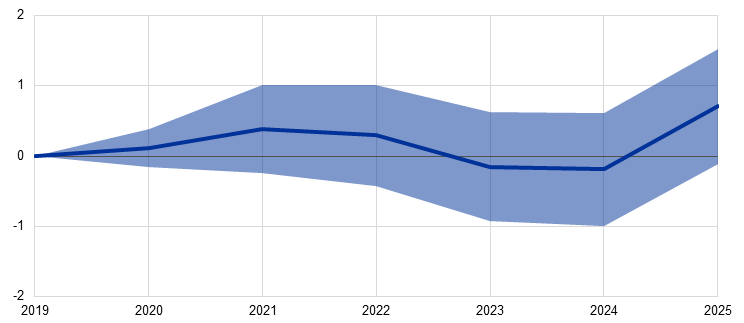
The relative impact of AI on job growth has not yet translated into significant differences in wage growth. As is the case for employment effects, although the impact of AI on wages and inequality is fiercely debated in the literature, empirical evidence of it is scarce. Using the same methodology as before, an analysis of median hourly wage growth by occupation reveals that AI substitution risk has had no significant impact on wage growth since 2019 (Chart C).[8] Over time, as the labour market continues to adjust and AI tools become more generative, income effects may be more pronounced.[9]
Chart C
Impact of AI on US wage growth – difference between high and low risk of substitution
(percentage points)
Sources: Bureau of Labor Statistics, Pizzinelli et al. (2023) and ECB staff calculations.
Notes: The line shows the estimated relative impact of AI exposure on median hourly wage growth for each year compared with 2019. The model uses a difference-in-difference approach and separately estimates the impact of an occupation’s risk of AI substitution on its wage growth for each year (2020-2025) compared with the base year (2019). The model also includes a constant and sector-specific fixed effects corresponding to three-digit NAICS subsectors. Results have been rescaled to indicate the difference between high and low AI substitution risk. The shaded area corresponds to the 95% confidence interval.
References
Acemoglu, D. and Restrepo, P. (2018), “The Race between Man and Machine: Implications of Technology for Growth, Factor Shares, and Employment”, American Economic Review, American Economic Association, Vol. 108(6), pp. 1488-1542.
Aldasoro, I., Gambacorta, L., Pal, R., Revoltella, D., Weiss, C. and Wolski, M. (2026), “AI Adoption, Productivity and Employment: Evidence from European Firms”, BIS Working Papers, No 1325, Bank for International Settlements.
Brynjolfsson, E., Chandar, B. and Chen, R. (2025), “Canaries in the Coal Mine? Six Facts about the Recent Employment Effects of Artificial Intelligence”, Stanford Digital Economy Lab.
Felten, E., Raj, M. and Seamans, R. (2021), “Occupational, industry, and geographic exposure to artificial intelligence: A novel dataset and its potential uses”, Strategic Management Journal, 42(12), pp. 2195-2217.
Hampole, M., Papanikolaou, D., Schmidt, L.D.W. and Seegmiller, B. (2025), “Artificial Intelligence and the Labor Market”, NBER Working Papers, No 33509, National Bureau of Economic Research.
Hui, X., Reshef, O. and Zhou, L. (2023), “The Short-Term Effects of Generative Artificial Intelligence on Employment: Evidence from an Online Labor Market”, CESifo Working Paper Series, No 10601, CESifo.
Lane, P.R. (2026), “AI and the euro area economy”, Keynote Speech at the ECB-SAFE-RCEA International Conference on the Climate-Macro-Finance Interface (3CMFI), European Central Bank, Frankfurt, 23 March.
Lambert, P. and Schindler, Y. (2026), “The Broken Ladder: AI, Remote Work, and Early-Career Hiring”, May, SSRN.
Lebastard, L. and Sondermann, D. (2026), “Artificial Intelligence: Friend or Foe for Hiring in Europe Today?”, The ECB Blog, European Central Bank, 4 March.
Massenkoff, M. and McCrory, P. (2026), “Labor Market Impacts of AI: A New Measure and Early Evidence”, Anthropic Economic Research.
Pizzinelli, C., Panton, A.J., Mendes Tavares, M., Cazzaniga, M. and Longji, L. (2023), “Labor Market Exposure to AI: Cross-country Differences and Distributional Implications”, IMF Working Papers, No 2023/216, International Monetary Fund.
Legal Disclaimer:
EIN Presswire provides this news content "as is" without warranty of any kind. We do not accept any responsibility or liability for the accuracy, content, images, videos, licenses, completeness, legality, or reliability of the information contained in this article. If you have any complaints or copyright issues related to this article, kindly contact the author above.
