

3D Printing Medical Devices Market to reach USD 12.91 Billion by 2035 at 15.8% CAGR
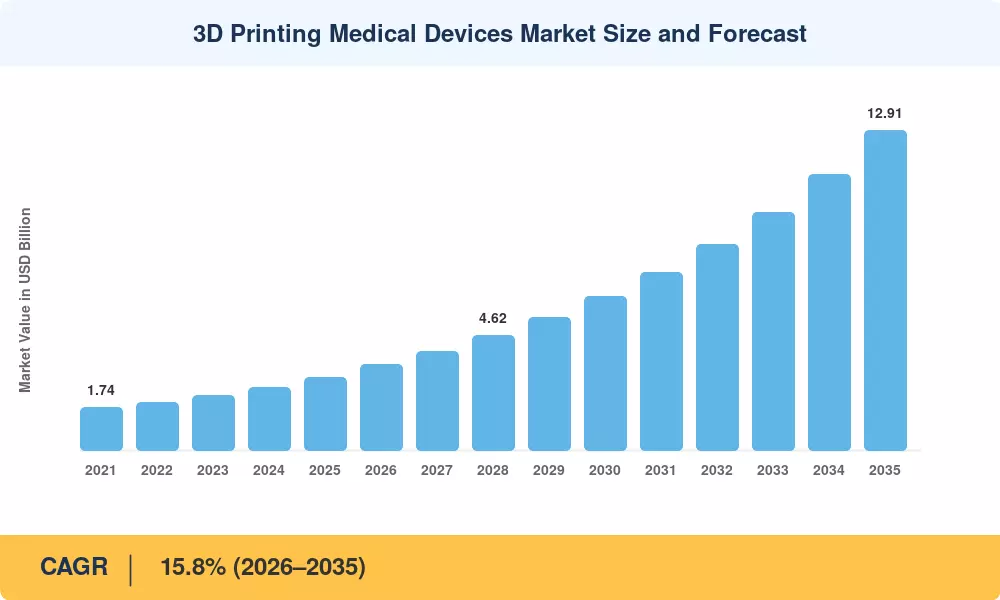
3D Printing Medical Devices Market Size
3D Printing Medical Devices Market to Surge from USD 3.45B in 2026 to USD 12.91 Billion by 2035-By Regulatory Pathway Clarity, and Material Science Advancements
NY, CA, UNITED STATES, July 20, 2026 /EINPresswire.com/ -- As per Market Research Future, the global 3D Printing Medical Devices Market size to reach USD 12.91 Billion by 2035 from USD 3.45 Billion in 2026, at a CAGR of 15.8% during the forecast period 2026--2035. The market base was estimated at USD 2.93 Billion in 2025.The 15.8% CAGR---anchored by structural healthcare infrastructure demand rather than discretionary technology spending---is driven by three converging forces: point-of-care manufacturing adoption that has compressed device lead times from weeks to hours and converted hospital systems into in-house producers, regulatory pathway clarity that streamlined FDA De Novo submissions and tripled patient-matched implant clearance rates between 2022 and 2024, and material science advancements that expanded the addressable device base beyond titanium into PEEK-based composites and biocompatible photopolymers.
National governments and multilateral health organizations are amplifying this momentum. The U.S. Veterans Health Administration allocated USD 14.2 million in FY2024 to deploy print laboratories across 12 VA medical centers, directly addressing the workforce and infrastructure gap that has constrained point-of-care adoption.
Request A Free Sample:
https://www.marketresearchfuture.com/sample_request/6830
Key Market Trends & Growth Drivers
Point-of-Care Manufacturing Adoption
Hospital systems across North America and Western Europe are building dedicated additive manufacturing laboratories within surgical departments. The Mayo Clinic reported that its in-house 3D printing program reduced average pre-surgical planning time by 68 minutes per complex case, translating to operating room savings of approximately USD 3,950 per procedure by eliminating iteration delays and third-party markups. The Veterans Health Administration allocated USD 14.2 million in FY2024 to deploy print laboratories across 12 VA medical centers, targeting craniofacial reconstruction and prosthetic socket fabrication. This decentralization of production puts the 3D Printing Medical Devices Market on a trajectory where end users become producers.
Facilities performing over 150 complex surgical cases per year typically achieve payback within 24--30 months on a mid-range polymer-metal printing setup. Below that threshold, outsourcing to certified service bureaus remains more cost-effective.
Regulatory Pathway Clarity for Patient-Specific Devices
The FDA's December 2023 update to its "Technical Considerations for Additive Manufactured Medical Devices" guidance document streamlined the submission process for patient-matched implants and surgical guides. Between 2022 and 2024, the agency cleared 27 new device classifications through the De Novo pathway---triple the rate of the preceding three-year period. This clarity de-risks R&D investment across the 3D Printing Medical Devices Market and shortens time-to-market from concept to cleared product.
The EU MDR's 2024 updated Annex I provisions for patient-specific devices injected EUR 310 million in compliance-driven capital investment across European manufacturers. Harmonization pressure from the EU Pharmaceutical Strategy is gradually narrowing national differences, lifting baseline demand across the region. Brazil's ANVISA introduced a streamlined regulatory pathway for 3D-printed surgical guides in 2024, reducing approval timelines from 18 months to under 9 months.
Material Science Advancements and Software-Driven Workflow Automation
Titanium alloy Ti-6Al-4V ELI remains the workhorse for load-bearing implants, but newer PEEK-based composites and biocompatible photopolymers are expanding addressable applications. ASTM International published four new additive-manufacturing material standards in 2024, covering powder characterization and mechanical property thresholds for medical-grade metals. Each new qualified material broadens the range of devices manufacturable through additive processes, directly expanding the 3D Printing Medical Devices Market's addressable base.
As hardware margins compress, vendors are pivoting toward recurring-revenue software platforms that manage digital inventory, automate design-for-manufacturing checks, and integrate with hospital EHR systems. This transition mirrors the shift seen in enterprise imaging and should boost the 3D Printing Medical Devices Market's software segment beyond the overall market growth rate.
Ask for Customization:
https://www.marketresearchfuture.com/ask_for_customize/6830
Market Segment Insights
BY OFFERINGS
Hardware: Dominant segment with ~64.1% revenue share in 2025. Reflecting the capital-intensive nature of industrial-grade metal and polymer printers deployed in hospital laboratories. Medical-grade printers from vendors like EOS, Stratasys, and 3D Systems carry high average selling prices, with industrial metal 3D printers ranging from USD 350,000 to USD 1.5 million per unit, without including annual maintenance contracts that add 8--12% of the purchase price.
Software: Fastest-growing offerings segment at 18.4% CAGR (2026--2035). Driven by design-to-print workflow platforms gaining traction among surgical planning teams. Cloud-based surgical planning platforms and digital inventory management tools generate recurring subscription revenues. Hospitals increasingly view software integration as the differentiator between standalone printers and operational manufacturing programs.
BY TYPE
Prosthetics and Implants: Dominant type segment with ~41.2% revenue share in 2025. Driven by titanium spinal cages and patient-matched knee components. Titanium and cobalt-chrome implants produced via laser beam melting now carry FDA clearances across spinal, cranio-maxillofacial, and hip replacement applications.
Surgical Guides: USD 0.67 Billion in 2024. High-volume, lower-ASP category that serves as the entry point for many hospital 3D printing programs---surgeons often adopt guides first before expanding into implant production. Pre-surgical planning accuracy drives sustained demand.
BY TECHNOLOGY
Laser Beam Melting: Dominant technology with ~37.5% market share in 2025. Remaining the gold standard for load-bearing metallic implants. Delivers superior density and is preferred for load-bearing implants, though equipment costs limit deployment to large university medical institutes and well-capitalized device OEMs.
Photopolymerization (UV): USD 0.72 Billion in 2025. Dental and surgical guide production anchors this segment. Photopolymer curing delivers anatomical models and dental aligners with high surface resolution.
Binder Jetting: Fastest-growing technology segment at 19.1% CAGR (2026--2035). Driven by faster batch production cycles for non-critical metal components. Offers 5--10x faster build rates at lower per-part costs, though post-processing sintering adds 12--18 hours per batch workflow complexity.
BY MATERIAL
Plastics (incl. Photopolymers): Dominant material with ~52.2% revenue share in 2025. Surgical guide and anatomical model production drives volume. Surgical guides, anatomical models, and dental aligners---the highest-volume device categories---all rely on photopolymer or thermoplastic feedstocks.
Metals (Titanium, CoCr): USD 0.89 Billion in 2025. Load-bearing implant requirements anchor this segment. Metal powders command higher per-kilogram prices but serve the premium implant segment where titanium's biocompatibility and mechanical strength are non-negotiable. Unused titanium and cobalt-chrome powder can be recycled through sieving and re-qualification for 8--12 build cycles before degradation affects mechanical properties.
BY END USER
Hospitals and Surgical Centers: Largest end-user segment with ~50.1% share in 2025. Point-of-care manufacturing programs dominate volume. Comprehensive oncology service lines and radiopharmaceutical administration requirements dominate volume. Hospitals remain the primary delivery site for bone cancer secondary treatment with alpha-emitters due to radiation safety infrastructure, specialized waste disposal, and nuclear pharmacy licensing requirements. Over 200 hospitals in the United States now operate dedicated point-of-care 3D printing programs.
Specialty Clinics: Fastest-growing end-user segment at 16.7% CAGR (2026--2035). Dental and orthopedic niche applications drive demand. Dental practices adopting chairside printing for crowns, bridges, and surgical guides represent a rapidly expanding channel.
Read Detailed Insights:
https://www.marketresearchfuture.com/reports/3d-printing-medical-devices-market-6830
Regional Outlook
North America -- Dominant Market (~42.2% Share, 2025)
The United States generates approximately 78.4% of North American 3D Printing Medical Devices Market revenue, driven by the CMS reimbursement framework for anatomical models (CPT code 0559T/0560T), commercial insurance coverage of patient-matched implants, and broad FDA device clearances---a single policy ecosystem that converted an outsourcing-dominated market into one with a structural point-of-care manufacturing tail. Over 200 hospitals now operate dedicated point-of-care 3D printing programs. The CMS reimbursement framework provided financial validation that accelerated adoption among orthopedic and cardiothoracic surgery departments, while community oncology networks increasingly prescribe subcutaneous cancer bone spread treatment options to manage infusion-center capacity. The US dominates through a combination of high per-procedure spending, robust payer coverage, and rapid point-of-care adoption.
Canada contributes through provincial health authority adoption at 13.8% CAGR, while Mexico is growing at steady pace on nearshoring of medical device manufacturing at USD 0.04 Billion in 2025. North America's leadership rests on reimbursement depth and the structural point-of-care segment created by expanded FDA De Novo compliance mandates and value-based healthcare contracts.
Europe -- Second Largest (USD 0.84 Billion, 2025)
Europe's 3D Printing Medical Devices Market reflects divergent national strategies---Germany leads regionally with Fraunhofer institutes and industrial additive manufacturing heritage, contributing 26.3% of regional share in 2025, while the UK historically used selective NHS Innovation Accelerator programs before broadening coverage through NICE technology appraisals for patient-specific devices at 14.9% CAGR. France contributes through AP-HP hospital network investment at USD 0.11 Billion in 2025. Italy contributes 11.8% of regional share on dental and maxillofacial device clusters. Spain is growing at 9.7% CAGR on public hospital modernization.
Harmonization pressure from the EU Pharmaceutical Strategy is gradually narrowing these differences, lifting baseline demand across the region. The European Commission's Horizon Europe program allocated EUR 180 million to medical device innovation clusters between 2023 and 2025, with a significant portion directed toward patient-specific implant development. The Nordic countries hold ~7.4% of regional share on university hospital partnerships. Russia contributes 4.1% of regional share on import substitution policies. Centralized health technology assessment bodies---NICE, G-BA, and HAS---have progressively widened reimbursement for patient-matched devices across surgical specialties.
Asia-Pacific -- Fastest-Growing Region (19.3% CAGR, 2026--2035)
Asia-Pacific is the engine of the 3D Printing Medical Devices Market. China holds the largest regional share with ~38.5% of regional revenue, driven by "Made in China 2025" medical equipment localization targets and NMPA approval of 14 domestically manufactured 3D-printed orthopedic implants in 2024---instantly signaling the country's intent to reduce reliance on imported devices. India is growing at 21.4% CAGR on the back of orthopedic procedure volume expansion and firms like Osteo3D and Anatomiz3D partnering with government hospitals to supply low-cost surgical planning models. Japan contributes USD 0.09 Billion through PMDA innovation pathway and aging population demand at steady pace. South Korea is growing at 17.8% CAGR on MFDS digital health device framework.
ASEAN economies hold ~6.8% of regional share on medical tourism infrastructure. The rest of Asia-Pacific is growing on early-stage adoption. The region's combined contribution anchors the global volume base for 3D printing medical device demand. Asia-Pacific represents the highest-growth opportunity, driven by a confluence of rising orthopedic procedure volumes, urbanization, and government investment in medical technology infrastructure. China performed an estimated 1.12 million joint replacement surgeries in 2024, a 14% year-over-year increase driven by its aging population and expanded public health insurance coverage for orthopedic procedures.
Middle East & Africa -- Emerging Opportunity (3.3% Share, 2025)
The Middle East & Africa is bifurcated between well-funded Gulf states and resource-constrained Sub-Saharan nations. Saudi Arabia leads the region with Vision 2030 healthcare cluster development, contributing ~31.2% of regional share---SAR 12 Billion earmarked for medical technology modernization, including dedicated funding for point-of-care manufacturing capabilities. The UAE is growing at 18.6% CAGR on Dubai Health Authority innovation mandates. South Africa contributes USD 0.01 Billion on academic hospital programs.
Egypt is growing at 11.3% CAGR on population-driven orthopedic demand. The rest of the region is growing on medical tourism growth. Diagnostic infrastructure gaps in LMICs remain a restraint---limited trained workforce for medical additive manufacturing constrains adoption rates. A 2024 RSNA survey demonstrated that formal training in medical 3D printing was provided by only 18% of US radiology programs, and the gap is greater in emerging economies. These workforce constraints lead to treatment delays and physician reluctance to initiate early preventive regimens, indirectly narrowing the 3D Printing Medical Devices Market addressable population.
Competitive Landscape and Recent Developments
The 3D Printing Medical Devices Market exhibits medium concentration, with the top five companies holding an estimated 45--52% combined revenue share. The Herfindahl-Hirschman Index sits in the 800--1,200 range, reflecting a competitive field where no single vendor dominates across all device categories and geographies. Patent expirations and open-source design libraries are gradually fragmenting proprietary segments, though pipeline innovation in next-generation biomaterials and AI-driven surgical planning sustains competitive moats for first-movers.
The competitive landscape is stratified between polymer printer pioneers serving global surgical guide markets, metal sintering specialists capturing premium implant tenders, and software platform developers consolidating the design-to-print workflow segment. Competitive dynamics are shifting from hardware differentiation toward software platforms, material portfolios, and workflow integration capabilities.
KEY COMPANIES AND RECENT MILESTONES
Stratasys (2024--2025): Maintains leadership with PolyJet and FDM printer portfolios and GrabCAD software, commanding ~10--14% of global 3D Printing Medical Devices Market revenue. Broadest polymer printer portfolio for surgical guides. Premium software positioning in specialty segments offsets hardware margin compression in competitive markets. Launched the J5 MediJet platform with five-material capability, enabling multi-durometer surgical planning models in a single print job, reducing model preparation time by 40% for complex cardiac and neurosurgical cases.
3D Systems (2024--2025): DMP metal printers and VSP surgical planning reinforce the integrated hardware-software-service model positioning, holding ~9--13% of global revenue. The company benefits from the structural software tail created by expanded design-to-print compliance mandates and value-based healthcare contracts. Acquired Kumovis GmbH, a Munich-based PEEK 3D printing specialist, for USD 43 million, strengthening polymer implant capabilities for spinal and cranial applications.
EOS GmbH (2024--2025): Metal and polymer laser sintering systems reinforce the premium industrial-grade implant production positioning, holding ~7--10% of global revenue. The company benefits from the structural metal implant segment created by expanded FDA clearances and EU MDR compliance mandates.
Materialise (2024--2025): Mimics software, 3-matic, and Materialise Medical reinforce the market-leading surgical planning software platform positioning, holding ~6--9% of global revenue. Software-driven workflow automation and digital inventory management generate recurring subscription revenues that offset hardware margin compression.
Future Outlook: 2026--2035
By 2030, AI-driven surgical planning automation will become the operating system of 3D printing medical device management. The convergence of deep learning algorithms and automated segmentation-to-design pipelines will reshape the 3D Printing Medical Devices Market through the late 2020s.
By 2030, AI-automated design platforms could handle 60% of routine surgical guide orders without human intervention. Deep learning algorithms that convert CT scans into print-ready surgical guide files in under 15 minutes---compared to the current 2--4 hour manual workflow---are already in beta deployment at five U.S. academic centers.
More Related Research Insights:
https://www.marketresearchfuture.com/reports/hypodermic-needle-market-41146
https://www.marketresearchfuture.com/reports/immune-checkpoint-inhibitor-market-42958
https://www.marketresearchfuture.com/reports/incontinence-devices-ostomy-market-42921
https://www.marketresearchfuture.com/reports/india-contact-intraocular-lenses-market-50174
https://www.marketresearchfuture.com/reports/india-intracranial-hemmorhage-diagnosis-treatment-market-56883
https://www.marketresearchfuture.com/reports/infection-control-in-air-market-55357
https://www.marketresearchfuture.com/reports/infectious-disease-drug-market-43143
https://www.marketresearchfuture.com/reports/injectable-anti-diabetic-drug-market-43153
https://www.marketresearchfuture.com/reports/insulin-infusion-pumps-market-43112
https://www.marketresearchfuture.com/reports/insulin-pen-needle-market-40898
Larry Wilson
WantStats Research And Media Pvt. Ltd.
+1 855-661-4441
email us here
Visit us on social media:
LinkedIn
Facebook
YouTube
X
Legal Disclaimer:
EIN Presswire provides this news content "as is" without warranty of any kind. We do not accept any responsibility or liability for the accuracy, content, images, videos, licenses, completeness, legality, or reliability of the information contained in this article. If you have any complaints or copyright issues related to this article, kindly contact the author above.
